Northern Lights Could Be Visible Over the Mid-South Monday Night as Geomagnetic Storm Watch Issued
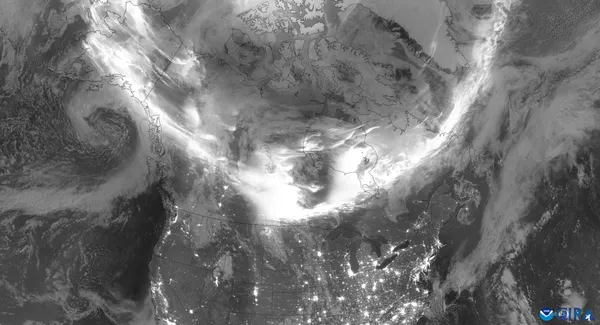
Rare chance for aurora sightings extends farther south than usual
Residents across the Mid-South could have a narrow window Monday night, January 19, to spot the aurora borealis, commonly known as the Northern Lights, if a strong geomagnetic storm develops as forecast. Space-weather forecasters have issued a severe (G4) geomagnetic storm watch for the UTC day of January 20, tied to the expected arrival of a coronal mass ejection (CME) that erupted from the Sun on Sunday, January 18.
The CME was associated with a strong (R3) solar flare from a sunspot region positioned near the center of the Sun’s disk, a geometry that can increase the odds that solar material intersects Earth’s magnetic field. Forecast timing indicates the disturbance could begin as early as late evening Monday in Eastern time, spilling into early Tuesday, though arrival and peak intensity can shift by hours.
What the forecast means for Memphis and surrounding areas
The Mid-South sits well south of typical aurora latitudes, meaning visibility—if it occurs—would most likely be low on the northern horizon rather than overhead. Forecast guidance suggests storm intensity may range from minor to strong (G1–G3) near arrival, with the broader watch allowing for severe conditions (G4) during the same period. Even with an elevated forecast, aurora visibility this far south is not guaranteed and depends on how strongly Earth’s magnetic field is disturbed and how clear the sky remains at peak time.
How to maximize your chances of seeing it
Choose a dark location: Get away from city lights. Rural areas north of the metro offer better odds than brightly lit neighborhoods.
Look north, not straight up: At Mid-South latitudes, any aurora is more likely to appear as a faint glow or shifting band near the horizon.
Time it around peak activity: The best opportunity is typically when geomagnetic activity spikes, which can happen in bursts over the course of the night.
Use a camera to confirm faint displays: Smartphone night modes and long-exposure photos can reveal color and structure that the naked eye may miss.
Why the aurora can reach the southern U.S.
Auroras occur when charged particles from the Sun interact with Earth’s magnetosphere and upper atmosphere, energizing gases that emit light. During stronger geomagnetic storms, the auroral oval expands toward lower latitudes, sometimes bringing visible aurora into parts of the central United States that rarely see it.
Even during strong forecasts, local viewing depends on short-lived geomagnetic surges, cloud cover, and light pollution—factors that can change quickly within the same night.
Conditions are expected to gradually weaken later Tuesday, with residual effects still possible into Wednesday, January 21.